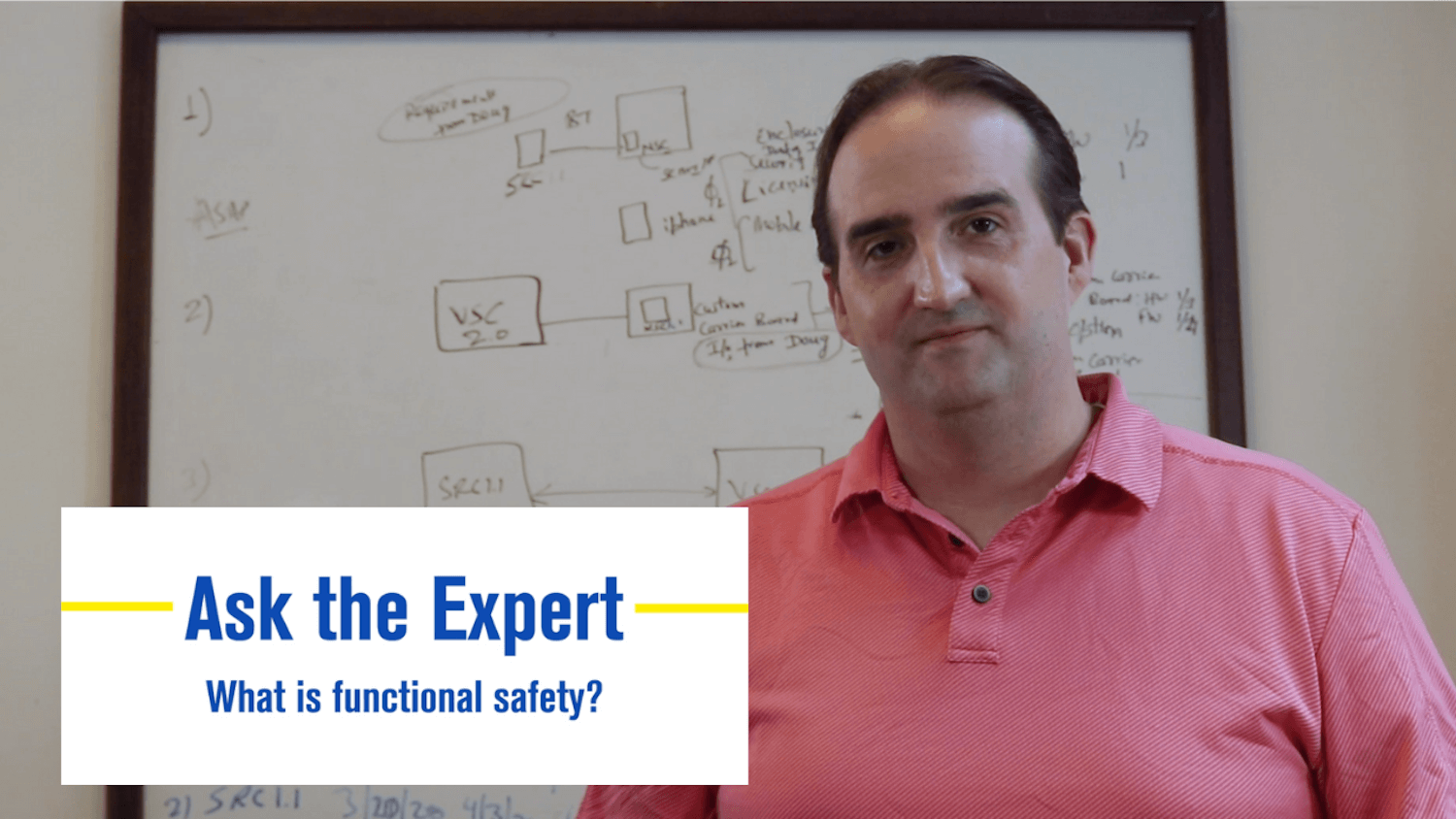
We're please to announce that Erica Murphy, Lead Systems Engineer at FORT Robotics, is now serving on the working group responsible for writing ISO/IEC TS 22440, which is expected to be the first formal international standard defining functional safety requirements for AI systems. The group, Joint Working Group (JWG 4), brings together experts in both AI and functional safety to define how safety-related systems should account for AI and machine learning components.
“This work is directly relevant to FORT's mission, since it's shaping the requirements that will govern how AI is safely integrated into robotics and other safety-critical systems,” said Murphy. “I’m looking forward to collaborating with this group.”
The working group brings together two international standards bodies: the International Organization for Standardization (ISO) and the International Electrotechnical Commission (IEC). Within them, two groups with very different expertise have joined forces.
JWG 4 is the joint working group formed between the two. Pairing AI expertise with functional safety expertise reflects the core problem the group is solving: functional safety standards were written assuming predictable, well-characterized failure modes, and AI systems don't behave that way. The group is convened by Riccardo Mariani, VP of Industry Safety at NVIDIA.
ISO/IEC TS 22440, Artificial intelligence — Functional safety and AI systems, is being developed as a Technical Specification (TS) in three parts:
It builds on ISO/IEC TR 5469:2024, an earlier Technical Report (TR) that surveyed methods for handling AI within functional safety but stopped short of setting requirements. TS 22440 takes the next step, giving engineers and certifying bodies a structured way to assess and reduce AI-specific risks, rather than treating AI as an unaddressed gap in frameworks like IEC 61508 and ISO 13849.
The project was approved in May 2024. Part 1 is now at the Committee Draft (CD) stage, an early draft circulated among committee members for review, with a comment period that closed in April 2026. Next comes the Draft Technical Specification (DTS) stage, a wider round of review and comment, before formal publication.
Traditional functional safety standards assume deterministic behavior and known failure modes: you can design it to fail safely. But AI and machine learning components are adaptive and data-driven in ways that break those assumptions. That can make certification of AI-enabled safety systems slow and inconsistent, because there's no shared framework for evaluating them.
The standards and specifications emerging from the SC 42 subcommittee, including TS 22440, are meant to give the industry that shared framework, covering how to define safety requirements for systems that evolve over time, how to evaluate AI models for robustness and transparency, and how to fold AI verification into the standard functional safety lifecycle.
FORT is working to make machines safer and more productive at scale. As AI becomes central to how next-generation machines perceive, decide, and act, safety can’t be bolted on afterward. It has to be shaped from the start, and that includes the standards that define what “safe” means.
The group writing TS 22440 is a crowded room. FORT sits alongside Nvidia, Google, Microsoft, IBM, Intel, Qualcomm, Lockheed Martin, John Deere, Agility Robotics, and government agencies including NIST and the FDA. That breadth shows how widely the question of certifying AI as safe now reaches across the industry.
FORT brings a practical perspective to that conversation: hands-on experience building, certifying, and deploying safety-critical systems on real machines in the field. Contributing that experience helps make the standard workable for everyone who has to apply it. It also deepens the expertise FORT shares with the companies we work with, so our customers don’t have to navigate AI safety alone.
Learn more on FORT's work on international standards organizations here.

Copyright © 2026 FORT Robotics, Inc. All rights reserved.